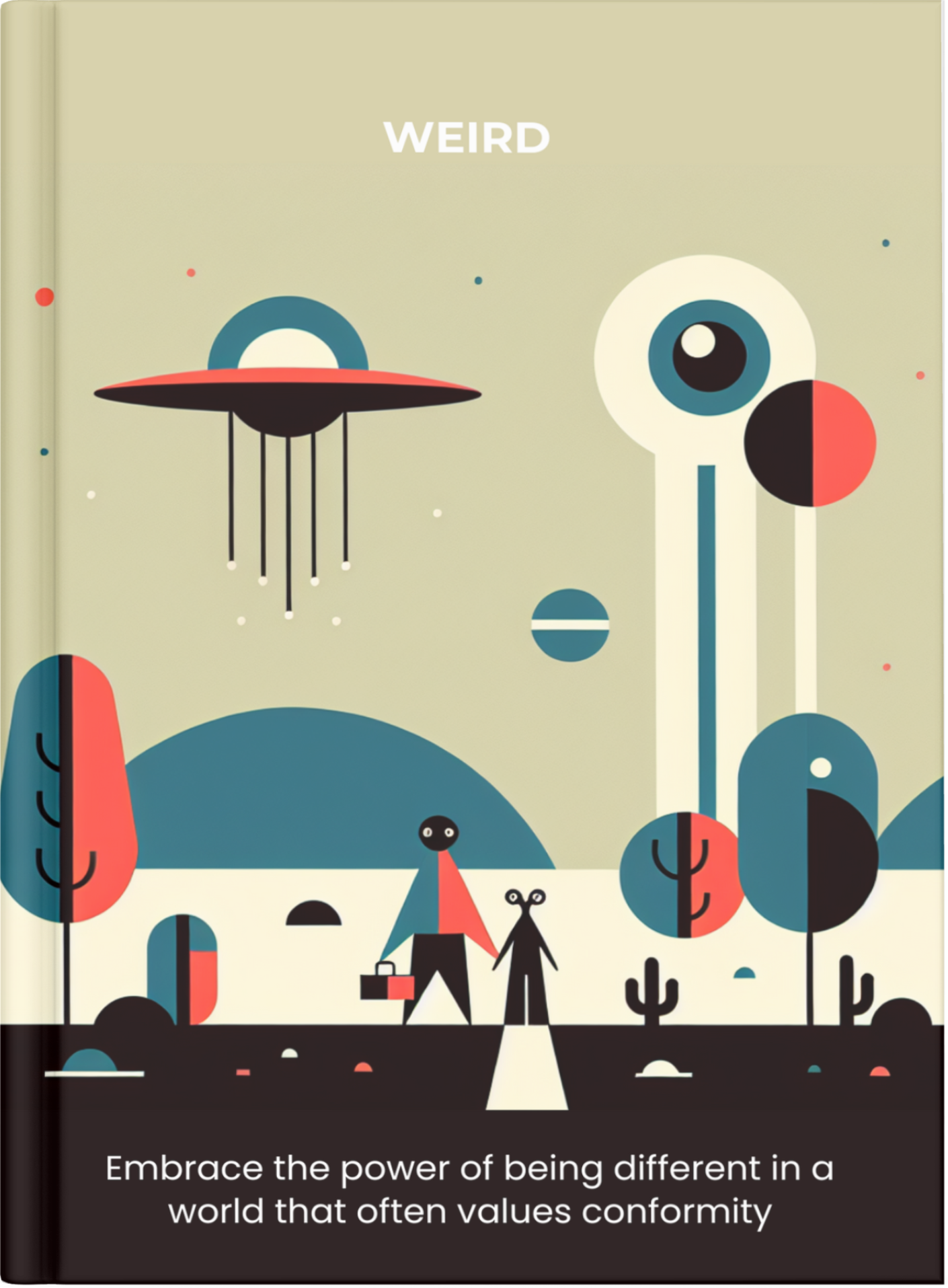
Weird
Olga Khazan
In 'Weird: The Power of Being an Outsider in an Insider World,' Olga Khazan explores the concept of being different and how it can be a source of strength rather than a weakness. Through personal anecdotes, interviews, and scientific research, Khazan delves into the challenges and advantages of being 'weird' in a society that often values conformity. The book provides insights into how embracing one's uniqueness can lead to personal and professional success.
0:000:00
Keypoint 1: The Definition of 'Weird'
In the opening chapters of 'Weird: The Power of Being an Outsider in an Insider World,' the concept of 'weird' is meticulously defined. 'Weird' is not merely a term for the eccentric or the odd; it is a label often assigned to those who deviate from societal norms and expectations. This deviation can manifest in various forms, such as cultural background, personal interests, physical appearance, or even unconventional career paths. The essence of being 'weird' lies in the divergence from what is considered 'normal' by the majority.
The book delves into the psychological and sociological aspects of this label. From a psychological perspective, being 'weird' can affect one's self-esteem and mental health. The constant pressure to conform can lead to feelings of isolation and inadequacy. However, it is also highlighted that this same label can foster resilience and a strong sense of self-identity. Sociologically, 'weird' individuals often find themselves on the fringes of social groups, which can be both a challenge and an opportunity. While they may face exclusion or misunderstanding, they also have the unique chance to view the world from a different perspective, often leading to innovative ideas and solutions.
The book also emphasizes that 'weirdness' is highly contextual. What is considered 'weird' in one culture or community may be perfectly normal in another. This relativity underscores the importance of understanding and embracing diversity. By redefining 'weird' as a form of diversity rather than a deficiency, the book sets the stage for a broader discussion on the value of different perspectives in both personal and professional realms.
Ultimately, the definition of 'weird' in this context is not static but fluid, shaped by societal changes and individual experiences. It challenges readers to rethink their perceptions and to see 'weirdness' as a potential source of strength and innovation rather than a drawback.
The book delves into the psychological and sociological aspects of this label. From a psychological perspective, being 'weird' can affect one's self-esteem and mental health. The constant pressure to conform can lead to feelings of isolation and inadequacy. However, it is also highlighted that this same label can foster resilience and a strong sense of self-identity. Sociologically, 'weird' individuals often find themselves on the fringes of social groups, which can be both a challenge and an opportunity. While they may face exclusion or misunderstanding, they also have the unique chance to view the world from a different perspective, often leading to innovative ideas and solutions.
The book also emphasizes that 'weirdness' is highly contextual. What is considered 'weird' in one culture or community may be perfectly normal in another. This relativity underscores the importance of understanding and embracing diversity. By redefining 'weird' as a form of diversity rather than a deficiency, the book sets the stage for a broader discussion on the value of different perspectives in both personal and professional realms.
Ultimately, the definition of 'weird' in this context is not static but fluid, shaped by societal changes and individual experiences. It challenges readers to rethink their perceptions and to see 'weirdness' as a potential source of strength and innovation rather than a drawback.
Unlock the Full Experience
Get access to complete book summaries and more with Wanlanid. Start your journey today by downloading our app on iOS or Android.